Latest Event Updates
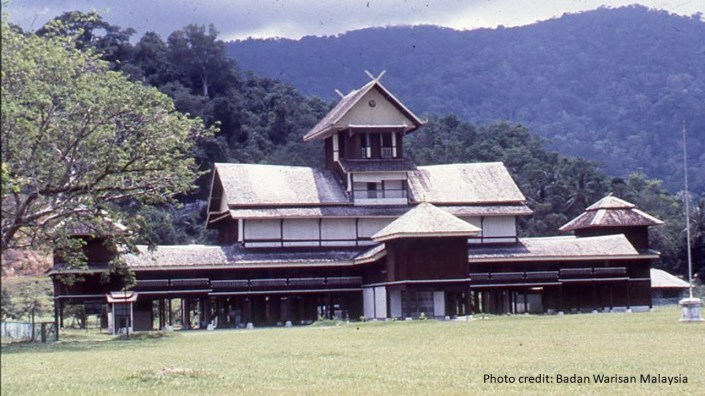
Members’ Trip to Seri Menanti and Paroi, Negeri Sembilan
Badan Warisan Malaysia
Members’ Trip to Seri Menanti and Paroi, Negeri Sembilan
Saturday 9 March 2019
Meet/Registration at Istana Lama Seri Menanti, 9.15 a.m.
Seri Menanti, the royal capital of the state of Negeri Sembilan, was established in 1773 as a loose confederation of luak (districts), by immigrants coming over from Sumatra (mainly Minangkabau). Of the original 9 districts (Sungei Ujong, Rembau, Jelebu, Jelai, Naning, Klang, Segamat and Ulu Pahang), hence its name, Negeri Sembilan, only the former five districts remain as part of the State today.
This visit is limited to a maximum of 40 pax, and will include a guided tour of the restoration of the Istana Lama as well as a talk and visit to some traditional houses in the area. After lunch, we will proceed to see the former Salinger House which has been relocated to a private estate near Seremban.
Registration fee for the trip is RM60/pax for members and RM85/pax for non-members. The fee is inclusive of lunch and some light refreshments.
The detailed programme will be provided to those who register for the trip.
Download registration form HERE and submit it to membership@badanwarisan.org.my
Let’s Talk Heritage: Preserving Place Names for their Cultural and Historical Contexts; Kampung Kerinchi – A Case in Point

The print and social media was all abuzz following the proclamation ceremony on 19 January 2019, when the urban settlement of Kampung Kerinchi which started in 1870s was declared to return to its original name, thus shedding its ‘up-market’ alias of “Bangsar South”, which nevertheless remains the name of one of the developments in the area.
Badan Warisan heartily welcomes this move; we believe it is high time Malaysians are more cognisant of the cultural, historical and communal contributions that have made Kuala Lumpur what it is as usually expressed in the original name of a place. We also advocate for the authorities responsible for the naming of areas and roads to take a stronger stand against approving names (and especially name changes) to support the gentrification rationale to ameliorate against the “inferior” connotation of the term “kampung”.
The coordination of geographical naming activities in this country is undertaken by the Malaysian National Committee on Geographical Names (MNCGN), which was established in 2002. At the state level, State Committees on Geographical Names (SCGN) are established to coordinate and implement the guidelines and procedures formulated by MNCGN. For the Federal Territory of Kuala Lumpur, the state committee is chaired by the Secretary General of the Federal Territories Ministry and its members comprise representatives from various government agencies, regulatory and enforcement bodies, including Kuala Lumpur City Hall, as well as private organisations and non-governmental organisations. This committee decides on the naming of areas, streets, including for new developments in Kuala Lumpur, and where a name is proposed by the developer, the committee takes into consideration the rationale for the name.
Kampung Kerinchi was formerly perceived as a squatter area and over the years much of the land here was bought over by developers, who branded their new developments with names of the more well-heeled neighbourhoods such as Bangsar (and in other areas, Damansara, Kiara, etc.) to widen their attraction.
The names of places do not exist in a vacuum; they have historic context and connections with ties to collective memories, sentiments, feelings and past. The naming of a place presents its identity and it reflects its roots and the communities who first settled in and developed the area. This significance is lost when names of places are changed.
Badan Warisan’s resources show that Kampung Kerinchi’s roots are closely linked to Kampung Abdullah Hukum. Kampung Abdullah Hukum was opened by Indonesian pioneer Abdullah Hukum, who came to Kuala Lumpur in the mid-1850s from Kerinchi, West Sumatra. Abdullah led the Kerinchi community who had accompanied him here, and eventually settled on Bungsar Road (now Jalan Bangsar) in what had come to be known as Kampung Abdullah Hukum. As an aside, we hope that Kampung Abdullah Hukum does not get “lost” in the regeneration of the area and becomes only known as KL Eco City!
While Kuala Lumpur’s official boundaries up to 1924 included Kampung Abdullah Hukum, it was only enlarged in 1954 to include this area of Kampung Kerinchi. It is noteworthy that Kampung Kerinchi was identified in the Kuala Lumpur Structure Plan 2000 as an urban renewal or redevelopment area, but its redevelopment in fact goes back to the 1990s, a decade or more before the Bangsar South development started.
Read: Know about the KL’s Cultural, History contribution, urges expert – New Straits Times, 2 February 2019.

Area Character Statement in Development Control Planning Case Study: Iskandar Malaysia Area Character Statement (IMACS)

ABOUT THE SPEAKERS
Nazri Noordin is the Managing Director of Iktisas Planners Sdn Bhd, with over 30 years of experience specializing in the fields of urban planning, urban design and conservation planning, and environmental consultancy. He graduated with a Dip. TRP (ITM, 1983), B.URP and M.URP (both from Illinois, 1986 and 1988 respectively). He is the Immediate Past President of the Malaysian Institute of Planners (2013-2017) and most recently, he led the team which won the 2018 MIP Award for Planning Excellence (Category: Heritage & Conservation) for the Iskandar Malaysia Area Character Statement (IMACS).
ABOUT THE LECTURE
TPr Nazri will outline the approach used in the Area Character Statement and how the IMACS study sought to define the character of the place by identifying the history, nature and culture which shaped southern Johor. This approach expands on the traditional approach of Development Control Planning which focuses on applying generic physical planning controls to one which integrates the character and heritage of the place with spatial and development planning.
Admission for lectures: RM30 (RM20 for Badan Warisan members)
A packed lunch will be provided
Limited to 35 participants.
To register, email us at lensa@badanwarisan.org.my
Multidisciplinary Approach in Heritage Conservation, Case Study: Langkawi UNESCO Global Geopark By UKM Governance and Education for Heritage Conservation Research Group


ABOUT THE SHARING SESSION
This sharing session will present the work carried out by UKM’s Governance and Education for Heritage Conservation Research Group on Langkawi Geopark (GAMAT). Langkawi Island, which was the first UNESCO Global Geopark in Malaysia as well as in Southeast Asia, can be a model for integrated heritage conservation and sustainable development. As a nature-based tourism destination, Langkawi Geopark has a huge responsibility to conserve its natural heritage (both geological and biological) as well as its cultural heritage. From their respective perspectives and specialisations, the GAMAT team will offers insights into some of the issues and challenges pertaining to Langkawi Geopark as a model for integrated heritage conservation and sustainable development. With the tagline ‘making the past present for the future’, this team sought to highlight the significance of heritage conservation which carries the spirit of Semangat Kawi by underlying the symbiotic relationship between heritage (of the past), current development (of the present) and the needs of the next generations (for the future).
ABOUT THE SPEAKERS
The GAMAT team comprises academics and researchers from different academic disciplines and includes Prof. Dr. Rahimah Abdul Aziz, Datin Paduka Dr. Halimaton Saadiah Hashim, Prof. Dr. Ong Puay Liu, Associate Professor Dr. Sarah Aziz, Associate Professor Dr. Geraldine K.L. Chan, Dr. Tanot Unjah, Dr. Lee Jing, Dr. Sharina Abdul Halim
Shared Spaces: New Buildings in Historic Settings by Ar. Dr. Helena Aman Hashim and Elizabeth Cardosa
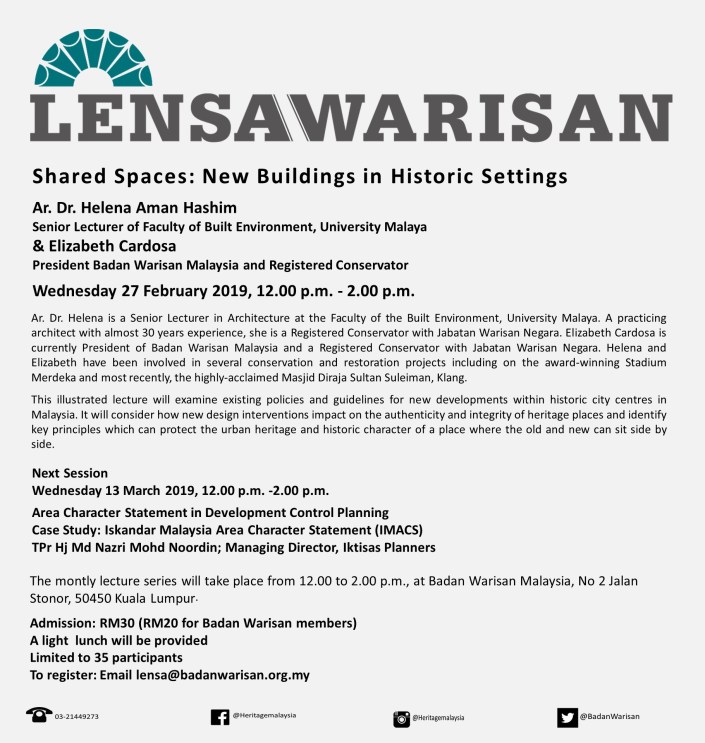
Lensa Warisan “Shared Spaces: New Buildings in Historic Settings” which was originally scheduled for 13 February 2019 has been postponed. It will now take place from 12 noon to 2pm on Wednesday 27 February 2019 at Badan Warisan Malaysia.
ABOUT THE SPEAKERS
Ar. Dr. Helena is a Senior Lecturer in Architecture at the Faculty of the Built Environment, University Malaya. A practising architect with almost 30 years experience, she is a Registered Conservator with Jabatan Warisan Negara. Elizabeth Cardosa is currently President of Badan Warisan Malaysia and a Registered Conservator with Jabatan Warisan Negara. Helena and Elizabeth have been involved in several conservation and restoration projects including on the award-winning Stadium Merdeka and most recently, the highly-acclaimed Masjid Diraja Sultan Suleiman, Klang.
ABOUT THE LECTURE
This illustrated lecture will examine existing policies and guidelines for new developments within historic city centres in Malaysia. It will consider how new design interventions impact on the authenticity and integrity of heritage places and identify key principles which can protect the urban heritage and historic character of a place where the old and new can sit side by side.
Admission for lectures: RM30 (RM20 for Badan Warisan members)
A packed lunch will be provided
Limited to 35 participants.
To register, email us at lensa@badanwarisan.org.my
Let’s Talk Heritage: Relocate and save but risk losing its authenticity? Or keep in-situ and risk losing it altogether?
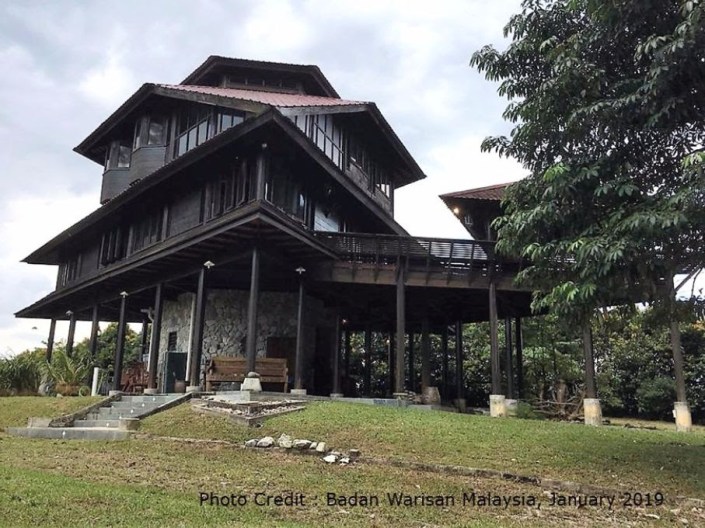
“Salinger House” Paroi, Negeri Sembilan. (2019)
The fundamental guiding principle in the most established of heritage charters, such as those championed by the International Committee of Monuments and Sites (ICOMOS), is the belief that locating a heritage building or structure from its original setting to a new site destroys its authenticity.
While there does not seem to be much discourse on this issue in Malaysia, expansive plaudits and acclamation have been forthcoming from established leaders in the Malaysian heritage arena for some recent projects which saw heritage buildings being relocated to new sites.
These include the so-named Rumah Pusaka Chow Kit a.k.a. “Rumah Degil”, was moved (2018) a distance of around two (2) km, and now sits snug between Balai Seni Negara’s main gallery building and its administrative annex block in Kuala Lumpur; and the “Salinger House” originally located in Bangi, Selangor (built 1985-1992), and which is in the last stages of being reconstructed in its new home near Seremban, Negeri Sembilan. This is a result of the house being sold a few years ago to its current owners after the land on which it was originally located was sold separately for redevelopment. Then there is the case of the century old Kampong Teluk Memali mosque being moved (2017) from the banks of the Perak River near Kampong Gajah to a new housing development in greater Ipoh, Perak. In 2004, the “Alma Baker house”, a two-storey (part brick and part timber) building masonry and timber house was dismantled in Batu Gajah, Perak, and reassembled in Setiu, Terengganu around 2010. And over 20 years ago Badan Warisan moved the Rumah Penghulu Abu Seman a much further distance, over 300km, from Kedah to Kuala Lumpur.

Rumah Pusaka Chow Kit a.k.a. “Rumah Degil”, in front of Balai Seni Negara’s main gallery building, Kuala Lumpur. (2019)
Add to this list the many other heritage buildings, too many to name, which have been “saved” because they have been relocated. It is perhaps timely for the many professionals and preservationists who fight to protect and safeguard our heritage resources to get together to discuss this issue. Should relocation be eschewed except in exceptional circumstances such as when there is no other option for saving the structure, and if not relocated, it will cease to exist? Should one wholeheartedly embrace this practice and promote adapting and relocating an existing building to meet changing economic and social needs in today’s society or is the cultural heritage significance of a building wholly bound to its original setting?
Mind you, the costs and risks of relocating a heritage building should not be underrated. Past experience has shown that this is an expensive exercise and that great care and much planning has to be put into place to ensure that the fabric of the building will not be damaged, and the new context within which the structure is moved is one which will offer as good, if not better, opportunity for the cultural heritage significance of the structure to be enhanced.
Badan Warisan would be very interested to hear from our readers on what could or should be the way forward. Please email lensa@badanwarisan.org.my if you would like to participate in a round-table discussion on this.
Elizabeth Cardosa
President of Badan Warisan Malaysia


LET’S TALK HERITAGE: A case for consensus-building and conflict-resolution for heritage place management
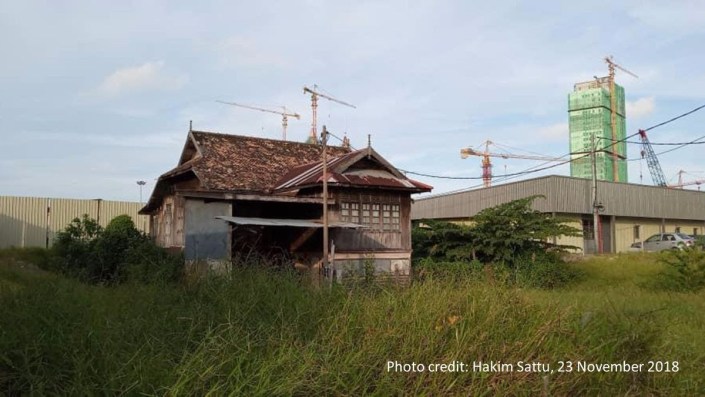
The recent demolition of a traditional Malay house in Kampung Tanjung Kelab Pantai, Terengganu, which was reported as standing in the way of the RM4.5 billion Kuala Terengganu City Centre project, has raised yet again concerns amongst many heritage professionals over the status of protection of the nation’s heritage.
In this past year, we have been privy to other controversies involving the loss of cultural heritage places – some through demolition such as that of Ampang Park Shopping Complex and the row of houses, commonly known as “Serani Row” in KL; others through development or major changes in the “look” of the place, as in the painting of the staircase leading up to the Batu Caves Temple complex.
So how do we really understand what is heritage?
The ways in which heritage is often framed today is through such regimes as the World Heritage Convention, and our own National Heritage Act 2005. In many countries, Malaysia included, heritage processes are legalistic, using adversarial court systems to determine the heritage significance of a place and to determine what are acceptable and appropriate actions to safeguard heritage.
Conflict arises when there is disagreement between involved parties who are responding to real or perceived threats to their interests, values, identities or rights; fears that one’s heritage is disrespected create highly charged emotions.
This lack of agreement will impede or prevent mutual understanding while ignoring the conflict in the hope it will dissipate over time is also ineffective. Conflicts present major barriers to achieving good heritage outcomes for all parties.
Fundamentally, heritage is a complex concept, engaging feelings and identities of the many different peoples and groups which make up our society. It connects what is culturally important to us – the individual, the family, any specific cultural group, up to the larger social framework we refer to as nation. There can be no one singular view of what is heritage; rather there are multiple perspectives reflecting the multiple values of multiple stakeholders.
These stakeholders each have distinct roles and different interests. They are also likely to have very different concepts of what comprises heritage. This in turn oftentimes results in conflict or differences of opinion.
So how does one determine the heritage significance of a place, and the appropriate action to be taken? Should a place be protected under law, or changes (including demolition), be allowed? How do we seek co-existence of these multiple values?
The heritage professional is one whose expertise places them in a position to present an independent, objective view, advocating for a particular position. But there are occasions when this position is challenged by another “expert” view, resulting in disagreement on the “facts” and adding to an already confused situation.
Those of us working to promote and protect our national heritage should be advocating for a consensus-building methodology, focusing on the core needs and concerns of all parties, centered on fundamental values and identities, and ultimately negotiating for an outcome which adjudicates between economic, social, environmental and political perspectives.
Almost all the time, conflict arises because heritage places are located within contested terrain – e.g. old two-storey shophouses in the city centre where the local development plans allow for much higher plot ratios, a bungalow on a relatively large piece of land which has been identified for high-rise redevelopment, etc. etc.
We have to break this head to head pitting of economic and utilitarian benefits against that of heritage conservation. We have to create a framework based on recognizing difference and one which helps build respect for all values and connections and to seek consensus.
Had there been any attempts for conflict-resolution, which may have prevented, or at the very least mitigated against, the very distressing and wasteful outcome of the demolition of this property in Kuala Terengganu?
We do not have any direct knowledge of the context which led to the traditional timber house being knocked down. We do know from having seen a video of the demolition that in a matter of minutes, all vestiges of a traditional village lifestyle was cancelled out.
Was it that the owner refused to move because he wanted more compensation, with the reported value of RM20,000 not a fitting sum while RM2 million would have made up for the loss of his family’s history and legacy? Was it that the officially (government) recognized owner of the land, felt vindicated because it was their legal right to get vacant possession of the land? The conflict over this contested site is reported to have been going on for at least a year, if not two. Everyone else in the kampong vacated their houses. Was this the last bastion, holding out and fighting for heritage rights?
Following our inaugural Lensa Warisan lecture & discussion of 14 November, Badan Warisan is planning to hold a forum early next year to discuss issues relating to the management of heritage sites and the principles we should be using to guide our heritage practices. More details later.
LENSA WARISAN: Understanding Impact Assessments (EIAs, SIAs, and HIAs) by TPr Ishak Ariffin

ABOUT THE LECTURE
This lecture will examine the methodology characterizing 3 different types of impact assessments which are employed in Malaysia. In order to ensure a robust and detailed impact assessment, the impact assessment process has been structured over a series of progressive and iterative stages. Join us as we will delve into the commonality in the different frameworks of Environmental (EIA), Social (SIA) and Heritage Impact Assessments (HIA).
ABOUT THE SPEAKER
Ishak Ariffin is the Managing Director of via Natura (Malaysia) Sdn Bhd, a consultant for heritage, social and environmental conservation planning. With over 30 years’ experience, Ishak is a registered Town Planner, a Fellow of the Malaysian Institute of Planners and Member of the Royal Town Planning Institute (UK). He is also a Registered Conservator with Jabatan Warisan Negara and a registered EIA Subject Specialist with the Department of Environment. He specializes in environmental planning and management, urban conservation as well as sustainable strategies and appraisals.
Admission: RM30 (RM20 for Badan Warisan members)
A packed lunch will be provided.
Limited to 25 participants.
To register email lensa@badanwarisan.org.my.
GWKL: Experiencing Pudu Jail’s Graffiti by Dr. K. Azril Ismail – 1 December 2018 – 28 February 2019


This exhibition is the part of the Gallery Weekend Kuala Lumpur 2018 programme hosted by Badan Warisan. It is open to visitors, free of charge, every day except Sundays and public holidays, from 1 December 2018 to 28 February 2019, 10.00 a.m. to 5.30 p.m.
There will be 2 Meet the Artist sessions:
(1) Saturday 15 December 2018, 11.00 a.m.
(2) Saturday 12 January 2019, 11.00 a.m.
Pudu Jail’s graffiti has become a prominent signifier within the Pudu Jail’s settings at the turn of the century. These sets of images were taken in 2002-03 but developing them took over a decade – through a series of monographs, black and white exhibitions, presentations, talks and forums; and with the involvement of NGOs and the Malaysian National Prisons Department.
Mentioning prisoners’ graffiti conjures up many different narratives in people’s minds – was it art, or was it cumulative of cultural languages? Was it influenced by the norms and cultural practices? Was it the caused by the morality decay, or a by-product from it? Get a glimpse of their etched narratives onto the walls and join in the discourse about the process of this art? Craft? Language of graffiti?
ABOUT THE ARTIST

Dr. K. Azril Ismail holds a Doctorate in Philosophy from the University of Plymouth, for his visual photographic studies of Pudu Jail’s graffiti.
He has been a practitioner of the early arts of 19th Century Photographic Processes since 2012; particularly on the daguerreotype and the wet plate Collodion process. These past image-making techniques became his current image-making methods, alongside utilising contemporary material studies, in which now became as a new chapter in his visual journey.
Read more about the exhibition and the artist HERE
 © 2026 BADAN WARISAN MALAYSIA. All rights reserved.