Author: Badan Warisan Malaysia (The Heritage of Malaysia Trust)
WHAT’S NEW: 255 Additions to the National Heritage Register 31 October 2018

On a warm mid-October afternoon in Kuala Lumpur, the Arts Hall of WowKL! Restaurant at the iconic MaTiC along busy Jalan Ampang bustled with activity. Distinct Malay background music accompanied the cordial chatter of guests and hosts alike, all orchestrally spilling into MaTiC’s patio where a temporary exhibition of celebrated heritage and cultural items was set up to mark the occasion.
And what occasion was that? The proclamation ceremony for the 5th edition of Malaysia’s National Heritage Register 2018.
Federal Minister and Deputy Minister for Tourism, Arts and Culture, YB Datuk Mohamaddin Ketapi and YB Tuan Muhammad Bakhtiar Wan Chik, accompanied by Secretary General YBhg Datuk Rashidi Hasbullah and other senior Ministry officials, joined hosts, Commissioner of Heritage YBhg Dato’ Dr. Zainah Ibrahim and her team at the Jabatan Warisan Negara (JWN), to proclaim the addition of 255 entries to the National Heritage Register (Register).
And, as it turned out, MaTiC was not only the event venue but also one of the 22 new buildings added to the Register.
National Heritage Designation
A practice founded in the National Heritage Act 2005 (NHA) and which began in 2007 with an inaugural 50 entries (including 16 classified as tangible architectural heritage) has over the years amassed hundred of entries under several distinct categories including ones covering heritage building or monuments, archaeological sites, natural sites, various tangible and intangible objects, and even, living persons, which was established for the 2012 edition.
The NHA, which became effective on 1 March 2006, was promulgated “… to provide for the conservation and preservation of National Heritage, natural heritage, tangible and intangible cultural heritage, underwater cultural heritage, treasure trove and for related matters”.
The NHA also establishes a 12-person National Heritage Council (NHC) and provides for the appointment of a Commissioner of Heritage empowered “to determine the designation of sites, registration of objects and underwater cultural heritage”, “to establish and maintain the Register and to determine and specify the categories of heritage to be listed in the Register”, and “to promote and regulate that best standards and practices are applied in the conservation and preservation of heritage” among other functions. The JWN supports the Commissioner in carrying out her functions.
Recognition as a National Heritage, and consequently protection for the same, is afforded through a process of gazettal. The Minister for heritage may gazette any heritage site, heritage object, underwater cultural heritage or living person as National Heritage based on a list of 9 criteria stated in s. 67(2) of the NHA. These criteria include “historical importance, association with or relationship to Malaysian history”, “the rarity or uniqueness” of the building, monument, site or object, and “any other matter which is relevant to the determination of cultural heritage significance”.

So, What’s on the National Heritage Register?
Many interesting items (and persons). Like what, you ask?
Well, among the now 72 national heritage buildings and monuments around the country, the earlier and better known entries include Bangunan Sultan Abdul Samad, Istana Negara and Tugu Negara in Kuala Lumpur; also the Stadhuys and the St. Paul’s Church in Melaka; as well as a string of heritage buildings in Kuala Kangsar, Taiping and Teluk Intan in Perak.
In the recent 2018 proclamation alone, 22 buildings were declared as National Heritage:
1. Masjid Melayu Leboh Aceh, Pulau Pinang
2. Masjid Kapitan Keling, Pulau Pinang
3. Fort Cornwallis, Pulau Pinang
4. Leong San Tong Khoo Kongsi, Pulau Pinang
5. Penang High Court Building, Pulau Pinang
6. Penang Free School, Pulau Pinang
7. The Telegraph Building, Taiping, Perak
8. Darul Ridzuan Museum, Perak
9. Bangunan Lama Pusat Pelancongan Malaysia (MaTic) and Dewan Tunku Abdul Rahman, Kuala Lumpur
10. The Old Building of Dewan Bahasa and Pustaka, Kuala Lumpur
11. The Sulaiman Building, Kuala Lumpur
12. Majestic Hotel, Kuala Lumpur
13. Istana Budaya, Kuala Lumpur
14. National Library of Malaysia, Kuala Lumpur
15. Bangunan Bank Kerapu (World War II Memorial), Kelantan
16. The State Museum, Kelantan
17. Maziah Palace, Terengganu
18. The Kuala Terengganu Grand Mosque / Abidin Mosque, Terengganu
19. Bangunan Sekolah Menengah King George V (Old Block), Negeri Sembilan
20. Pengulu Md. Nattar’s House, Melaka
21. Fort Malawati, Selangor
22. Fort Kuala Kedah, Kedah
On the Register now too are Candi Bukit Batu Pahat (Tapak 8) and Candi Pengkalan Bujang (Tapak 23), both found in Bujang Valley, Kedah, making up the list of 14 archaeology heritage sites in all.
The tally of natural heritage sites remained at 7, inclusive of such gems as Taman Diraja Belum in Grik, Perak, the Mulu Caves National Park in Sarawak, as well as Taman Negara Kinabalu in Sabah.
Please visit the Jabatan Warisan Negara website for the full National Heritage Register.
How should we designate National Heritage?
While we were pleasantly surprised to see the Malay-Chinese-European style architectured Penghulu Md. Nattar’s House in Melaka – the first traditional house added to the Register – we remain concerned by the lack of public awareness to the guiding principles adopted by JWN which facilitate their evaluation of the 9 criteria for National Heritage listing, especially for the “cultural heritage significance” criterion at the national level.
We believe that such awareness is of great importance to help guide the understanding, and consequently, appreciation by members of the public as to the significance of our heritage, and hopefully lead to a greater resolve in calling for the protection, conservation and preservation of the same. To this end, our upcoming Lensa Warisan series lecture on 14 November 2018 will feature our Vice-President Ar. Dr. Helena Aman Hashim on the topic of Understanding the Criteria for Listing of Buildings as Warisan Kebangsaan. Do join us if you can, details are found here.
Justine Chew
Council Member of Badan Warisan Malaysia
Lensa Warisan

This is a series of monthly lectures & moderated discussions organized by Badan Warisan to explore key elements of built heritage conservation. Designed for architects, planners, academics as well as professionals involved in cultural expressions and heritage tourism, Lensa Warisan aims to promote greater knowledge sharing for more effective protection and management of our built and cultural heritage resources. Join us as we unravel a new topic every second Wednesday of the month at Badan Warisan Malaysia, No 2 Jalan Stonor, 50450 Kuala Lumpur.
Wednesday 14 November 2018,
12.00 p.m. – 2.00 p.m.
Understanding the Criteria for Listing of Buildings as Warisan Kebangsaan
By Ar. Dr. Helena Aman Hashim
This session will closely examine the criteria for listing of properties on the Daftar Warisan as found in Section 67 (2) of the National Heritage Act (2005). Together, we will critically weigh how the different criteria have been applied to buildings which are gazetted as Warisan Kebangsaan and also appraise how the application of these criteria hold up against that from other countries.
Next session:
Wednesday 12 December 2018,
12.00 p.m. – 2.00 p.m.
Understanding Impact Assessments (EIAs, SIAs and HIAs)
By TPr Ishak Ariffin, Director, Via Natura Sdn Bhd
Admission: RM30 (RM20 for Badan Warisan members)
A packed lunch will be provided.
Limited to 25 participants.
To register email lensa@badanwarisan.org.my.
WHAT’S LEFT : Ampang Park Shopping Complex
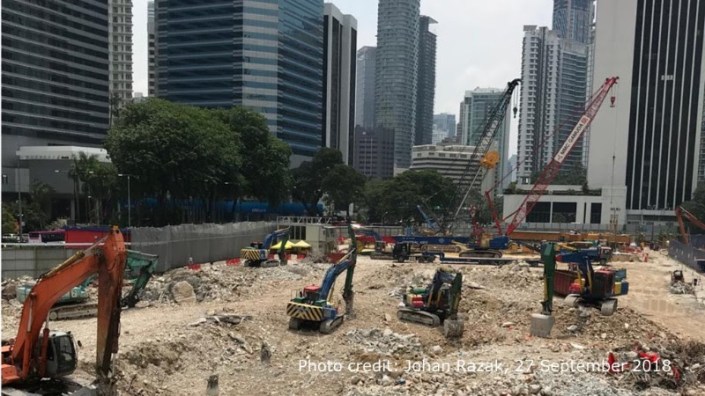
12 October 2018
Over the Malaysia Day holidays in mid-September 2018, the Ampang Park Shopping Complex in Kuala Lumpur was demolished. When we came back to work after the holidays, all we saw where the building had once stood were several earth movers shifting rubble.
Over the past couple of years, following the news that this complex was going to make way for the MRT (no doubt, part of the city’s sorely needed transportation infrastructure development), there were many expressions of regret and a lot of nostalgia making the rounds both in social media as well as main stream media. It was obvious that Ampang Park Shopping Complex held great memories for many who grew up in KL in the 1970s, 80s. And, if one were to go by the comments on the demolition, it even holds a place in the hearts and minds of those who have lived in KL in the 1990s and early 2000s.
This overwhelming sentiment demonstrates that this building was so much a part of the heritage of our city. It certainly validates the inclusion of this shopping complex in Pertubuhan Akitek Malaysia’s (PAM) publication, “Guide to Kuala Lumpur Notable Buildings” (1976) which listed 71 structures built between the 1880s and 1974 which PAM deemed to be of architectural merit and historical importance.
A quick survey of the list shows that over half the structures listed were built by the late 1930s and would for most part be considered to be “heritage”; credit must be given to the forward-looking authors, that the remaining 32 are modern buildings, constructed in the two decades post-Merdeka.
About a dozen, eight of which are from the latter group, have been replaced by other, bigger, higher density developments. Some, such as the AIA Building on Jalan Ampang with its original distinctive diamond-shaped sunscreen of iodised aluminium, have been substantially changed to be unrecognisable. A few are vacant and their futures unknown to us while several others have had major developments in their immediate vicinity with later-day high-rise blocks substantially extending their floor space.
For the most part, religious and education-related buildings have remained extant, although there have been a couple which have been demolished and new, larger, grander structures built to replace them. Some others, like the old hospital at Tanglin, were demolished and replicas built, looking almost alike, but using new materials; which begs the question why they were demolished in the first place.
Many of those from the list which remain have in one way or another been changed, upgraded, updated, refurbished to meet new uses and current building standards and accessibility, some for the better, with the jury still out for others.
It is, however, a sad testament to KL’s architectural history that today, the buildings considered by PAM as iconic, deserving to be preserved as part of the architectural heritage of Kuala Lumpur, and which contributed to our national architectural identity, are no longer with us.
As we come towards the end of 2018, perhaps it is time to take another look at this list of notable buildings of Kuala Lumpur, to hopefully take stock of what remains, and to extend this list to include others built since the mid-1970s. With a more comprehensive inventory of notable buildings for the city, Badan Warisan Malaysia would hope that these will in the future be acknowledged and “protected” by the owners, statutory authorities and KLites, as an integral part of the architectural, historical and cultural character of our city.
Elizabeth Cardosa
President of Badan Warisan Malaysia
Talk on Memories of a Malaccan: A Pictorial Recollection of the 1920s to 1960s by Audrey Lim


ABOUT THE TALK
Audrey has written “Memories of a Malaccan” as a tribute to her father, Lim Keng Watt (1909-1996). She has selected images from his vast collection of photographs and postcards and has drawn on his notes, documents and other memorabilia to highlight significant aspects of the socio-political scene of Malaya before, during and after World War II. She will talk about her father’s life and times – as student and teacher, Scout, sportsman, soldier, musician and drama enthusiast. The nostalgic pictures and interesting mementos she shares will fascinate both general readers and history buffs
ABOUT THE SPEAKER
Audrey Lim is a Founder-member of Malacca Theatre Group. Has helped the MTG organise inter-school drama competitions. Also acts and helps regularly in its productions. Served as President of the MTG for 3 terms. She wrote a book titled Write with Success originally published by Longmans, now revised and reprinted as Write It Right ; now in its 12th. edition. Recently she wrote 2 short plays for the latest Malacca Theatre Group production Snippets held in November 2016, one of which was a historical but fictionalized play about her aunt who had been jailed by the Japanese during the Occupation, while the other Beauty and the Bard was in the finals of the Short and Sweet drama fest in KL.
Talk on The Future of Intangible Knowledge with Reference to Pua Kumbu by Dr. Welyne J. Jehom


ABOUT THE TALK
The importance of intangible cultural heritage is the wealth of knowledge and skills that is transmitted through it from one generation to the next. Pua kumbu, a tie and natural dye resist textile in Sarawak, has long been known as sacred traditional cloths woven on backstrap looms by the Iban women weavers. As an aesthetic material culture, the pua kumbu possesses a unique identity that carries the legend, stories and rhymes that are inseparable from the traditional Iban cosmology and belief system. Once a ritualistic cloth, at present day, the pua kumbu has become only the symbol of Iban identity and cultural pride because of transformations in their belief system, way of life and education.
The knowledge and skills in the production of pua kumbu are becoming very scarce amongst the young generation of Iban women, most of whom treat this intangible cultural heritage as the knowledge and skills of their grandmothers. It is becoming a dying art. Collective memory seems to be the only way to restore the fragments of knowledge and skills of pua kumbu production – identification of the name of design, motif, rhyme and story for each design ever produced in the past. The application of memories of pua kumbu narratives as the path to identify each pua kumbu ever produced is guarded by traditional intellectual property rights owned by families who have the recognized ownership of designs; it can give both positive and negative impacts in the work of conservation and restoration of the knowledge.
ABOUT THE SPEAKER
Dr. Welyne Jeffrey Jehom is currently under the Department Of Anthropology And Sociology in the Faculty Of Arts And Social Sciences of the University of Malaya.
She is of Bidayuh descent, born and raised in Kuching, Sarawak. She is motivated to be in the academic world in an effort to prove the highest of education qualifications is achievable despite having limited resources available and being a woman – one needs is the motivation. Therefore, in Dr. Welyne’s research in recent years, she focuses on problems that hinders development and the progress of the community she is dear to, and research that deals with the development of the community from within
Talk on Care and Conservation of Manuscripts and Books (II) by Alex Teoh


ABOUT THE TALK
Alex Teoh is a paper and book conservator, active in restoration and collection care for rare manuscripts, collectable prints, ephemera, antique maps and antiquarian books. Trained in the UK, he has been working on various heritage centres, libraries and private collection in Malaysia, Singapore and Brunei. Since his first talk/presentation at Badan Warisan in 2012, Alex returns to share further on the conservation and restoration scene in Malaysia and our Nusantara area.
ABOUT THE SPEAKER
Alex is a member of the International Institute of Conservation of Historic and Artistic Works (IIC) and the Society of Bookbinders in the UK. Locally he is a member of Badan Warisan Malaysia and Manassa (The Indonesian Association of Nusantara Manuscripts)
Brought To Delight: Sultan Suleiman Royal Mosque Exhibition
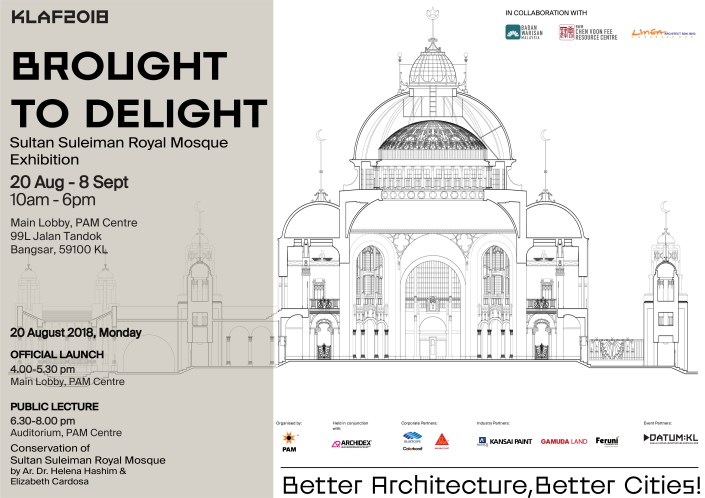
ABOUT THE EXHIBITION
BROUGHT TO DELIGHT
20th Aug – 8th Sept 2018, 10am – 6pm
Main Lobby, PAM Centre
FREE admission
As part of a collaboration and partnership between Badan Warisan Malaysia, Linea Architect Sdn Bhd with KLAF2018 and Pertubuhan Akitek Malaysia (PAM), BROUGHT TO DELIGHT is an exhibition featuring the recently conserved Sultan Suleiman Royal Mosque, Klang, curated and produced by Badan Warisan Malaysia.
ABOUT THE MOSQUE
The Sultan Suleiman Royal Mosque was officiated as the Suleiman Jamiur Rahmah Mosque when it was completed in 1933. The building was designed as an octagonal garden pavilion-like structure at the foot of the old Astana Mahkota Puri in Klang. It was the largest concrete structure in Malaya in 1933 – quite an engineering feat at a time when reinforced concrete was relatively new.
An Art Deco edifice, the mosque stands as one of the most unique religious architecture in the country. The ambitious project involved close consultations with the fifth Sultan of Selangor, Sultan Alaeddin Suleiman Shah, who selected the site and vetted through the design and planning details. Design credits go to the architect, Leofric Kesteven (Chairman of the Malayan Institute of Architects from 1931 to 1933); John Thomas Chester, the reinforced concrete specialist attached to United Engineers Ltd; and Rodolfo Nolli, the Singapore based Italian sculptor who worked on the ornaments of the building.
The mosque has stood for over eight decades, but not without transformations to its interior and Ablution Pavilion, affecting its original design intentions. Jabatan Kerja Raya Negeri Selangor, with assistance from the Jabatan Warisan Negara and Jabatan Agama Islam Selangor, had successfully completed the restoration of the mosque in November 2017. The building has been brought back to its original 1933 appearance (as closely as possible), which includes the uncovering of colourful bas-reliefs adorning its upper walls and its original sunken ablution pond.
As consultants to Jabatan Kerja Raya Negeri Selangor, Linea Architect Sdn. Bhd. and Badan Warisan Heritage Services had worked together in recording the original architectural details and the construction process involved in the restoration of the Sultan Suleiman Royal Mosque from 2015 to 2017. These records serve as references to understand Malaya’s architectural scene in the early 1930s and would be displayed at PAM Centre from 20th to 26th August 2018.
The Sultan Suleiman Royal Mosque was placed under the National Heritage list in 2012. A ceremony to mark the completion of its restoration took place on 3 November 2017, officiated by the Sultan of Selangor, HRH Sultan Sharafuddin Idris Shah Alhaj.
Talk on Valley of Hope: Sungai Buloh Settlement


ABOUT THE TALK
ABOUT THE SPEAKER
Originating from Finland, the term ‘VERNADOC’ (vernacular documentation) refers to a methodology of vernacular architecture study that emphasizes the information and data collection on site using basic techniques to produce high quality measured drawings. Having gained international recognition, the use of VERNADOC is expected to result in drawings that will provide an insight into the heritage element to the value of measured buildings with the goal of incentivizing building owners and inspiring community members to join hands in conserving those buildings.
The Wilderness Among Us: New Horizons in Urban Nature Conservation by Benjamin Ong
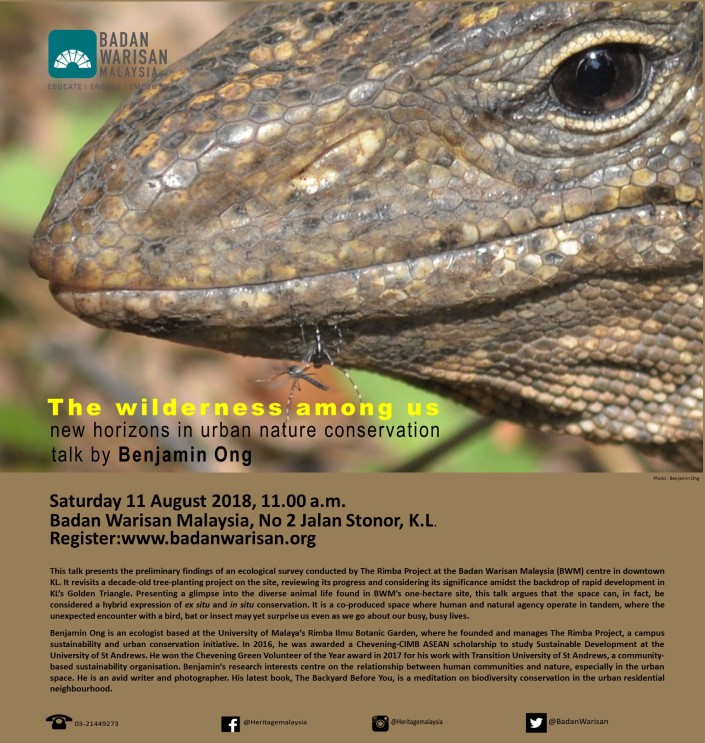

ABOUT THE TALK
We live in the Anthropocene, an age where humans might as well be gods. Across the world, rapid development, deforestation and other forms of environmental degradation are driving habitats and species to extinction faster than we can save them. More than 75 per cent of Malaysians now live in urban areas, generally disconnected from the bulk of nature conservation efforts that take place in large swathes of remaining natural ecosystem far from towns and cities.
Meanwhile, in spite of human action, nature exerts her own agency. While we encroach on wild areas, a sizeable number of plants and animals demonstrate remarkable resilience in adapting to urban settings. While urban areas are seldom associated with biodiversity conservation, patches and pathways of habitats and ecological corridors exist within the city. These support wildlife and challenge our assumptions of sterility, our understanding of urban green space, and our expectations of green cities.
This talk presents the preliminary findings of an ecological survey conducted by The Rimba Project at the Badan Warisan Malaysia (BWM) centre in downtown KL. It revisits a decade-old tree-planting project on the site, reviewing its progress and considering its significance amidst the backdrop of rapid development in KL’s Golden Triangle. Presenting a glimpse into the diverse animal life found in BWM’s one-hectare site, this talk argues that space can, in fact, be considered a hybrid expression of ex-situ and in-situ conservation. It is a co-produced space where human and natural agency operates in tandem, where the unexpected encounter with a bird, bat or insect may yet surprise us even as we go about our busy, busy lives.
ABOUT THE SPEAKER
Benjamin Ong is an ecologist based at the University of Malaya’s Rimba Ilmu Botanic Garden, where he founded and manages The Rimba Project, a campus sustainability and urban conservation initiative. In 2016, he was awarded a Chevening-CIMB ASEAN scholarship to study Sustainable Development at the University of St Andrews. He won the Chevening Green Volunteer of the Year award in 2017 for his work with the Transition University of St Andrews, a community-based sustainability organisation. Benjamin’s research interests centre on the relationship between human communities and nature, especially in the urban space. He is an avid writer and photographer. His latest book, The Backyard Before You, is a meditation on biodiversity conservation in the urban residential neighbourhood.
BWM MEMBERS’ VISIT TO MASJID DIRAJA SULTAN SULEIMAN, KLANG
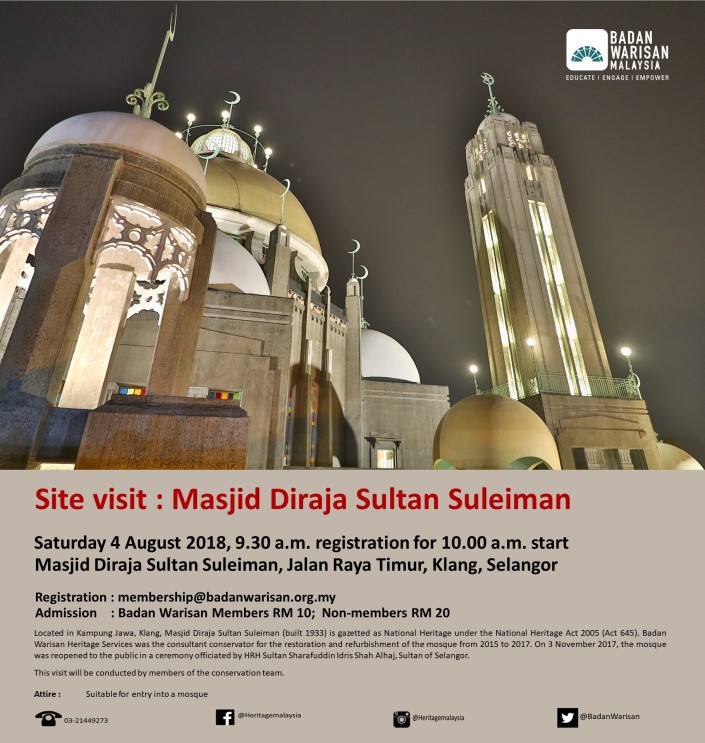
VISIT TO MASJID DIRAJA SULTAN SULEIMAN
SATURDAY, 4th AUGUST 2018
9.30 a.m
[Limited to 50 pax]
Located in Kampung Jawa, Klang, Masjid Diraja Sultan Suleiman (built 1933) is gazetted as National Heritage under National Heritage Act 2005 (Act 645). Badan Warisan Heritage Services was the consultant conservator for the restoration and refurbishment of the mosque from 2015 to 2017. On 3 November 2017, the mosque was reopened to the public in a ceremony officiated by HRH Sultan Sharafuddin Idris Shah Al-Haj, Sultan of Selangor
The visit will be conducted by members of the conservation team.
Attire: Suitable for entry into a mosque
Members: RM10
Non-Members: RM20 per person (Free for kids below 8)
Download registration form HERE and RSVP to
membership@badanwarisan.org.my
 © 2026 BADAN WARISAN MALAYSIA. All rights reserved.